


Post Hot Topics
July 2025 – World UFO Day
July has arrived, bringing with it a lighter summer mood, holidays on the horizon, and, for the more curious, the subtle hum of something otherworldly cruising in the skies above. While the early days of the month may feel relatively uneventful on the surface, it is worth noting that July 2nd was officially recognised as World UFO Day.
While it might not seem as immediately pressing as last month’s Hot Topic on sustainability and environmental protection, World UFO Day still offers a seamless shift in focus—from sea to sky—inviting just as much depth of discussion as the Pacific Ocean itself.
And to be honest, we wager that just reading the word “UFO” likely sparked a reaction…
A dismissive smirk, smile, or eye-rolling to convey doubt.
A raised eyebrow followed by a forward lean to convey fascination or confusion.
A wide, genuine smile or an energetic nod to convey excitement.
A shudder accompanied by a slight gasp or tensing of the shoulders, hinting at fear or unease.
A few thoughts related to extraterrestrial lifeforms (perhaps even one trying to phone home).
Whatever the reaction, it’s clear the topic of UFOs touches something deeply human: awe, wonder, fear and even scepticism. With that said, what exactly is a UFO?
This seemingly simple question is already divisive, yet it is crucial to answer as it provides essential context.
By definition, a UFO, or Unidentified Flying Object, is any aerial object that cannot be readily identified or explained. That is all.
No little green aliens. No spaceships. Just unidentifiable things that fly; fast-moving birds, drones, experimental aircraft and others that warrant squinting to identify.
Or so one may think…
Over time, the word has collected layers of meaning, shaped not only by science fiction, Cold War paranoia, and government secrecy but also by specific moments such as Project Blue Book or Nevada and the many Area 51 debates which even led to the theft of a farmer’s postbox being stolen and replaced with a new mysterious landmark. Here are a few historic sightings before we focus on modern events and explore why UFO Day was established:
Ancient Egyptian UFOs?
When considering the origins of UFO sightings, most individuals tend to reference the year 1947, often citing two specific incidents (that we shall address later). However, what tends to fly under the radar is the vast history of aerial phenomena that predates the more “modern” UFO sightings.
To prove this point, a few ancient sites have sparked as much speculation as the Great Pyramids of Giza, while commonly understood to be the tombs of pharaohs, also seem to have architects and astronomers interested: Their precise alignment with celestial bodies, remarkable construction accuracy, and unexplained internal chambers have led some scholars and theorists to question whether their purpose might have extended beyond what is currently accepted.

Although many speculations are told about this renowned wonder, they gain even more intrigue when paired with a questionable document: the Tulli Papyrus. While the original artefact has not been found, existing translations tell of a remarkable event that occurred during the reign of Pharaoh Thutmose III, where the skies above Egypt were filled with “circles of fire”. These objects were described as silent, luminous objects that moved in formation and radiated a brilliance exceeding that of the sun. These discs reportedly hovered in the atmosphere before ascending higher into the sky, leaving behind a pungent, smoky residue.
What follows in the account is even stranger: it is said that after the objects departed, fish and birds rained down from the heavens, an event that defies natural explanation and contributes to the narrative’s mysterious tone.
Is any of this real?
Despite its intrigue, the real Tulli Papyrus has never been physically located or authenticated. What exists is a transcribed version, allegedly copied by Boris de Rachewiltz from a papyrus once seen in the collection of Vatican official Alberto Tulli.
Leading scholars widely consider it a fabrication or, at best, a misunderstood religious or astronomical text.
If taken literally, the idea of mysterious glowing objects in the sky that are rumoured to outshine the sun could conflict with the deeply rooted beliefs of ancient Egyptians, particularly those of Ra, the sun god.
The “circles of fire” could be a poetic interpretation of natural phenomena such as solar halos, comets, or meteor showers. Likewise, with the fish and birds dropping out of the sky, this could have been a rare but documented meteorological event caused by waterspouts or strong winds.
Although the story is alluring, the Tulli Papyrus lacks the credibility and physical evidence necessary to be considered a reliable historical account.
Omens and Ovals in the Middle Ages?
Another tale in history recounts one of the most dramatic mass sightings of unexplained aerial activity that occurred over Nuremberg, Germany, on April 14th, 1561.
That morning, townspeople reported seeing a surreal spectacle in the sky that contained many strange shapes locked in an aerial battle that lasted an hour before falling to earth and “burning up”. This event was so striking that a local printer, by the name of Hans Glaser, captured what he had seen unfold through a detailed woodcarving that was also backed up by a broadsheet describing what he had seen:
Spheres, cylinders, crosses, and even an enormous black spear.
Needless to say, a Star Wars-esque celestial battle in the heavens would have been viewed with both awe and dread. In the 16th century, most unusual events – let alone those in the sky – were interpreted as omens believed to be signs or warnings of the future, as religion played a central role in everyday life.

Is any of this real?
Despite its intrigue, the real Tulli Papyrus has never been physically located or authenticated. What exists is a transcribed version, allegedly copied by Boris de Rachewiltz from a papyrus once seen in the collection of Vatican official Alberto Tulli.
Leading scholars widely consider it a fabrication or, at best, a misunderstood religious or astronomical text.
If taken literally, the idea of mysterious glowing objects in the sky that are rumoured to outshine the sun could conflict with the deeply rooted beliefs of ancient Egyptians, particularly those of Ra, the sun god.
The “circles of fire” could be a poetic interpretation of natural phenomena such as solar halos, comets, or meteor showers. Likewise, with the fish and birds dropping out of the sky, this could have been a rare but documented meteorological event caused by waterspouts or strong winds.
Although the story is alluring, the Tulli Papyrus lacks the credibility and physical evidence necessary to be considered a reliable historical account.
Omens and Ovals in the Middle Ages?
Another tale in history recounts one of the most dramatic mass sightings of unexplained aerial activity that occurred over Nuremberg, Germany, on April 14th, 1561.
That morning, townspeople reported seeing a surreal spectacle in the sky that contained many strange shapes locked in an aerial battle that lasted an hour before falling to earth and “burning up”. This event was so striking that a local printer, by the name of Hans Glaser, captured what he had seen unfold through a detailed woodcarving that was also backed up by a broadsheet describing what he had seen:
Spheres, cylinders, crosses, and even an enormous black spear.
Needless to say, a Star Wars-esque celestial battle in the heavens would have been viewed with both awe and dread. In the 16th century, most unusual events – let alone those in the sky – were interpreted as omens believed to be signs or warnings of the future, as religion played a central role in everyday life.
Is any of this real?
The 1561 Nuremberg sighting is often described as a mass UFO encounter. Still, the primary source of the woodcut and broadsheet, created by Hans Glaser, was never intended as a literal eyewitness report by modern standards.
It was created in an era when unusual celestial events were commonly interpreted as religious or apocalyptic signs before the emergence of modern technology.
The various shapes Glaser described, such as spheres, crosses, and cylinders, are widely believed to be caused by an atmospheric optical phenomenon that can create vivid illusions around the sun at dawn.
The dramatic aerial battle may have been a mix of natural spectacle and cultural perception, where artistic interpretations often blended fact, belief, and metaphor.
Despite claims that it was witnessed by “many townspeople,” there are no other diaries, letters, or testimonies to justify the incident, which is highly unusual for such a dramatic scene overhead.
While the event probably was visually striking, it is far more likely a case of 16th-century skywatchers interpreting natural phenomena through the lens of religious symbolism, rather than being a reliable historical record of a fleet of UFOs.
So, why do unidentified objects in the skies above deserve a whole day of recognition? The answer lies in two key events that sparked the modern-day scene, which coincidentally happen to share a significant year for all odd overhead objects.
Get up to speed with all modern UFO events by clicking the link below:
Passionate about making a positive impact and tackling the challenges of the present and future to help the enviroment? Why not dive a little deeper and explore an apprenticeship in Corporate Responsibility and Sustainability?
These two key events, both occurring in 1947, are:
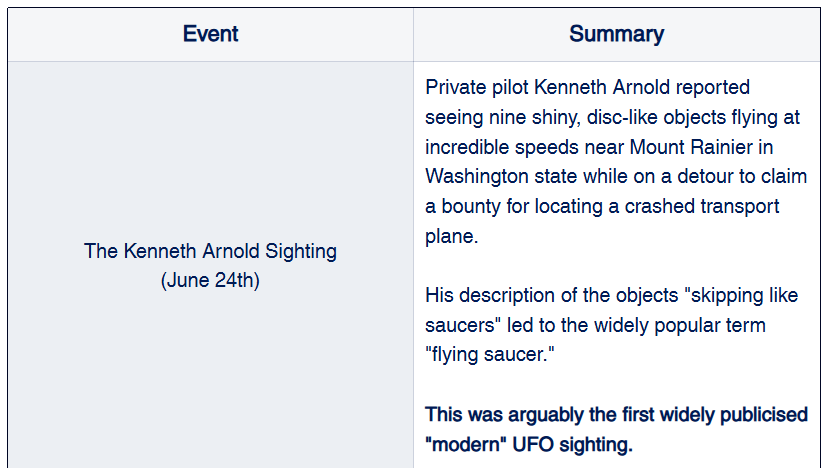
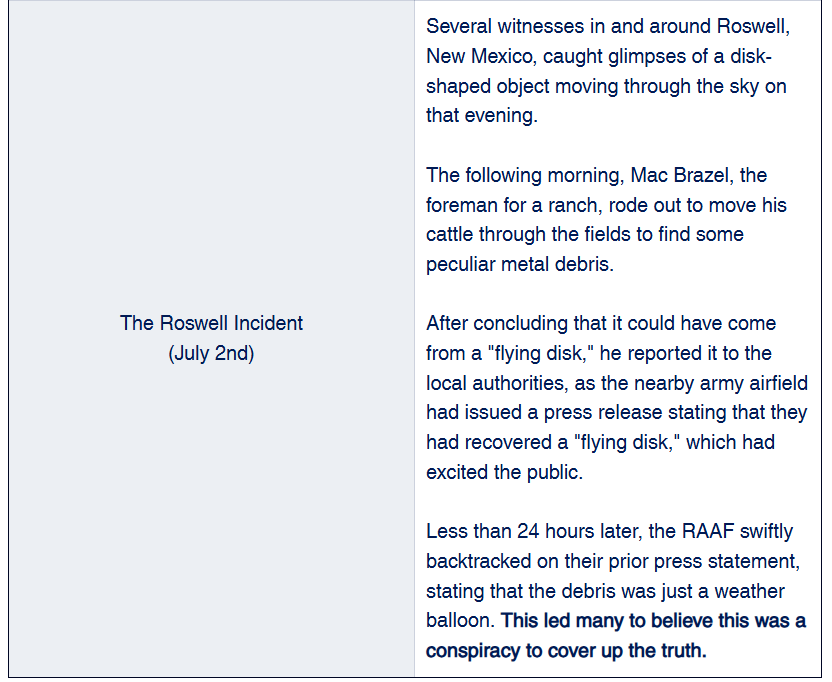
Subsequently, World UFO Day was first officially organised in 2001 by Haktan Akdogan, a Turkish UFO researcher and founder of the Sirius UFO Space Sciences Research Center.
Unlike these phenomena, his goal was straightforward:
Gather and share information about UFO sightings and raise awareness about their existence.
Demand government transparency by declassifying information surrounding UFOs
Reflect on the possibility that we are not alone in the universe and promote open-minded discussions around the possibility of extraterrestrial life
Speaking of things that go under the radar frequently, what about a feeling that comes in various shapes that most of us carry?
Loneliness. That deep, unpleasant feeling which arises when there is a void in one’s heart. It is something tainted by disconnection and abandonment, yet it is still a universal experience. It can lurk in the middle of a crowd or when surrounded, making one feel small, and is challenging to describe with only words.
It can also be fleeting, hitting for a few moments, or lingering for months and years. It can often be misunderstood as solitude, hiding behind exhausted smiles, busy schedules, or constant pings of notifications. Yet, despite this, loneliness rarely receives attention due to being overshadowed by other excuses, such as shame, bravado, and weakness, and is often dismissed when the factors that cause it do not apply.
To address this, Marmalade Trust, a UK charity based in Bristol, decided to flip the script by treating it as what it is: a normal feeling. It is not something that should be kept secret or viewed as a personal failure. So much so that in June 2017, Loneliness Awareness Week took place from the 9th to the 15th and has occurred annually since then.
It came and went just like World UFO Day, so why bring up two events that have passed for this Hot Topic out of the blue?
Two answers. One: to tease at the possibility of an upcoming Hot Topic for next year, where we shall revisit other types of loneliness. Two: because existential loneliness remains a type of loneliness that often goes unrecognised and unexplained due to its philosophical nature.

A clear night sky full of stars is a marvel to behold, but can lead to questions about a bigger picture…
For some, the idea that we might not be alone in the universe offers a peculiar comfort. The concept that somewhere out there, another form of intelligent life might be looking up at the same stars, feeling the same sense of wonder… or perhaps a similar longing as many others may feel. Possibly, there may be life, Jim—but not as we know it.
Sure, World UFO Day may seem quirky, but it’s that emotional crossover with existential loneliness that’s rarely acknowledged that matters the most, as this confronts our desire to be seen, understood, and to matter, whether by other humans or something much greater. In that sense, both World UFO Day and World Loneliness Day carry a shared message:
Connection is a human desire worth reaching for regardless of distance.
- Should ideas, like UFOs, be openly explored?
- How does the government’s openness about unexplained things build trust, or should there be more transparency?
- How can different beliefs about the unknown be respectfully discussed?
- Does curiosity about space reflect a shared human desire for answers?
- If seeking life elsewhere, is there enough effort to foster our own connections?
Related Content
Post Hot Topics
March 2026 – Neurodiversity Celebration Week
04th March 2026
5 mins read
Post Hot Topics
February 2026 – Safer Internet Day
01st February 2026
7 mins read
Post Hot Topics
January 2026 – A Long December
01st January 2026
6 mins read